 AIImageInsight
Have you ever stood before a blank digital canvas, your mind teeming with visions, yet your fingers hover motionless over the keyboard? The right words to conjure the image in your soul remain stubbornly elusive. For years, we've wrestled with text prompts, trying to translate the pictures in our heads into strings of descriptive commands for AI. But what if the image itself could be the prompt? In 2026, Google Labs' Whisk has quietly transformed that 'what if' into a tangible, breathing reality, offering a sanctuary for the visually inspired but verbally weary.
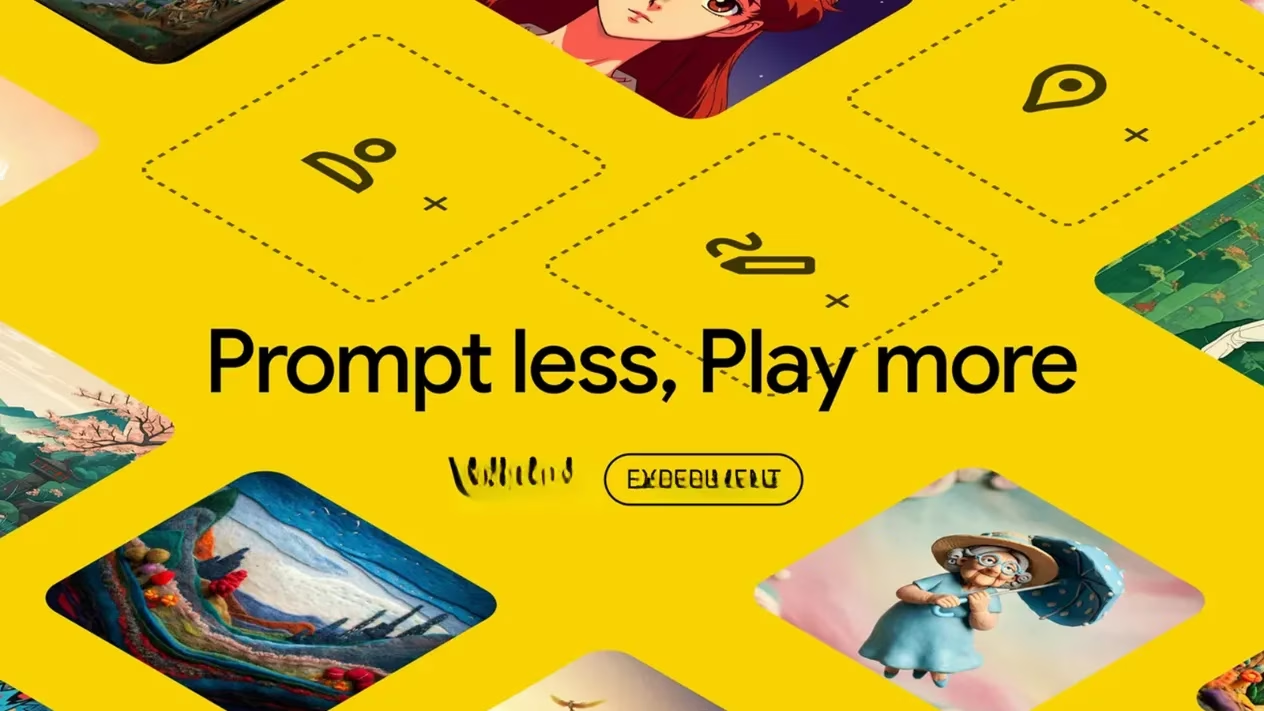
Whisk is not merely another tool in the crowded AI image generator arena; it is an experiment in a new language of creation. Where others ask for elaborate incantations of text, Whisk extends a simple, profound invitation: show me. The core of its magic lies in its tripartite altar of inspiration: Subject, Scene, and Style. Instead of painstakingly describing a 'vintage-style holiday card of a cat lying in the snow,' you can now upload a cherished photograph of your own cat, a wintry landscape painting you adore, and a scanned postcard from the 1920s. Whisk then performs its alchemy, 'whisking' these visual ingredients into a coherent, new whole. Isn't it liberating to think that our creative references no longer need to pass through the bottleneck of language?
Yet, Google has not abandoned the written word. Whisk masterfully creates a symbiotic dance between image and text. For each visual reference you upload, the platform automatically generates a detailed written description. This is where the tool reveals its thoughtful design. Imagine you upload a moody, rain-soaked cityscape for 'Scene.' Whisk might articulate it as "a neon-reflective wet asphalt street at night under a heavy downpour." If the generated image is almost perfect but missing that one element—say, a stray cat under a flickering streetlamp—you don't start from scratch. You simply edit that auto-generated text, adding ", with a small black cat seeking shelter," and Whisk refines its vision. This fluid feedback loop between what you show and what you describe makes the creative process feel less like issuing commands and more like a collaborative conversation.
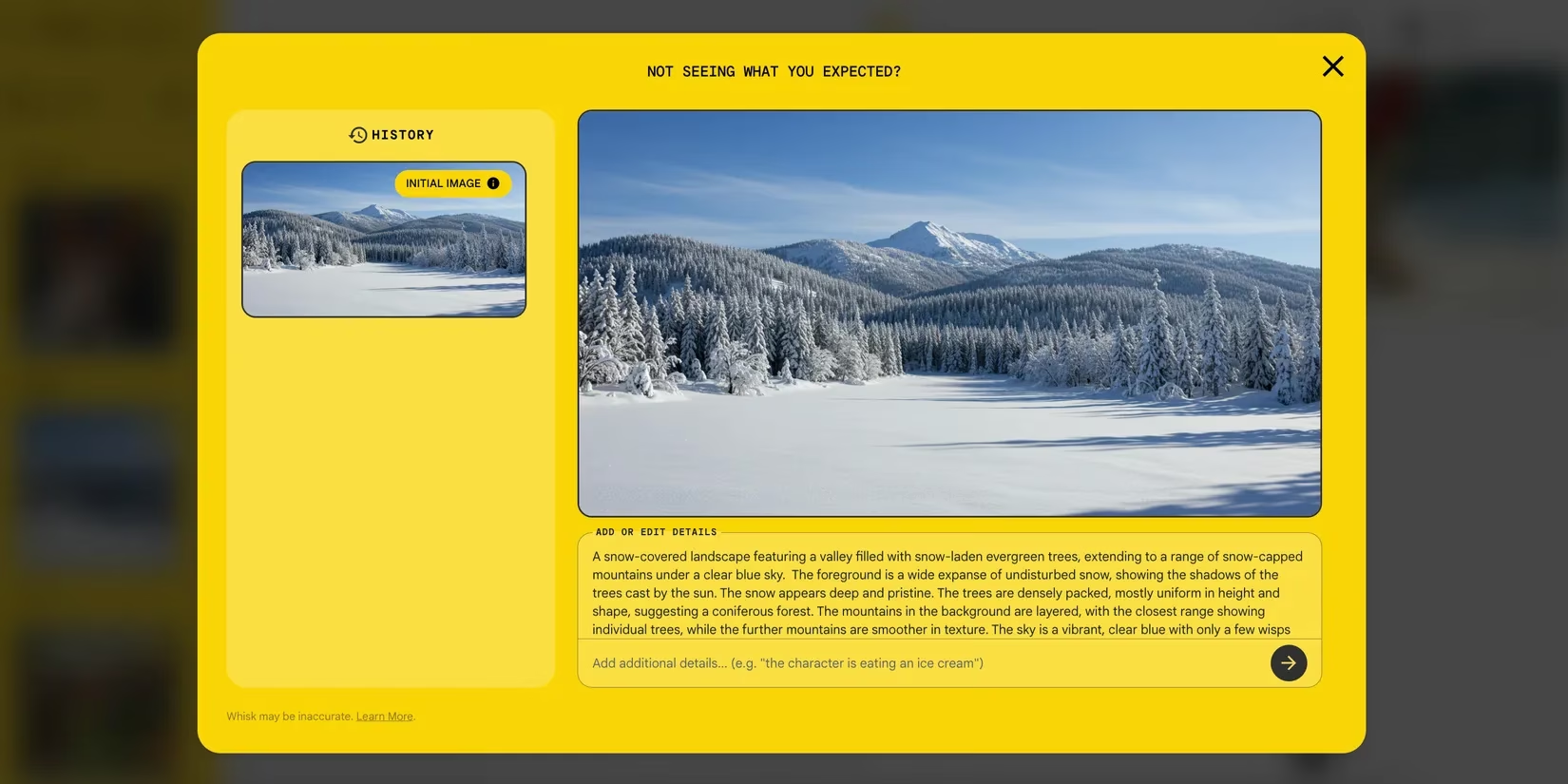
Where does Whisk truly find its home in a creator's workflow? Google is clear: this is a tool for exploration and ideation, not pixel-perfect final renders. Its power shines in the messy, beautiful early stages of a project. Consider these scenarios where Whisk becomes an indispensable partner:
-
The Pitch Deck Architect: You have a client's brand imagery that defines a specific aesthetic—clean lines, a particular shade of blue, minimalist composition. Instead of spending hours trying to describe this 'feel' to a standard AI, you upload the brand guide images into Whisk's 'Style' category. Within minutes, you have a dozen concept images for your deck that visually harmonize with the existing brand identity, maintaining a coherent visual language that words alone could never guarantee.
-
The Inspired But Stuck Artist: You're sketching concepts for a graphic novel. You want a character in a cyberpunk market, but the scene feels flat. With Whisk, you can drop in your character sketch as the 'Subject,' a bustling night market photo as the 'Scene,' and screenshots from Blade Runner as the 'Style.' A click generates a fusion you can then use as a base for your own detailed illustration, breaking you out of creative block.
-
The Rapid Prototyper: Need to visualize ten different concepts for a product's social media campaign? Whisk's 'randomize' function—the die icon—is your best friend. Load a product shot as the 'Subject,' and let Whisk cycle through countless 'Scenes' and 'Styles,' from 'sun-drenched beach' to 'cozy coffee shop ambiance.' You can generate a mood board's worth of ideas in the time it would take to write a single detailed prompt for another AI.
The table below contrasts Whisk's philosophy with more traditional, prompt-reliant AI image generators:
| Aspect | Traditional Text-to-Image AI | Google's Whisk (2026) |
|---|---|---|
| Primary Input | Descriptive text prompts | Visual references + optional text |
| Creative Workflow | Linear, language-dependent | Associative, visual-first |
| Best For | Rendering specific, well-described concepts | Brainstorming, exploring visual themes, mood boarding |
| Strength | Precision from clear instructions | Serendipity and fusion of visual ideas |
| User Experience | Like writing a detailed script | Like collaging and remixing in a visual notebook |
So, is Whisk just a gimmick in a field of powerful competitors? From my own journey with it, I can say resoundingly: no. Its uniqueness is its recognition of a fundamental truth in human creativity: we often think in pictures, not paragraphs. When I'm designing, I don't first think 'serif font, muted palette, negative space.' I see a feeling, a composition, a memory. Whisk allows me to start from those fragments of visual memory. It understands that sometimes, the most accurate prompt is a sigh and a pointed finger at another image, saying, "Like this, but... more magical." Or *"Like that, but make it mine."
As we move forward, tools like Whisk signal a maturation of AI from a literal command interpreter to an intuitive creative partner. It acknowledges the gap between our internal vision and our descriptive ability and builds a bridge made of imagery itself. In a world saturated with words, Whisk offers a moment of quiet, potent visual dialogue. It reminds us that sometimes, to create something truly new, we don't need to find the perfect words—we just need to show what inspires us and let the AI listen with its eyes.
Comments