 AIImageInsight
In the ever-evolving digital landscape of 2026, AI photo editors promise the moon and the stars, offering to transform your snapshots into masterpieces with a single click. They've become ubiquitous, integrated into everything from social media apps to professional suites, whispering sweet nothings about saving time and effort. But for the discerning eye, the seasoned photographer, or even the hobbyist who cares about the final product, these AI-powered wizards often feel more like overzealous interns than master craftsmen. They promise control but deliver compromise, offering convenience at the cost of creativity. Let's pull back the curtain on these digital assistants and examine why, despite their flashy algorithms, they often leave a lot to be desired.
The Illusion of Control 🎮
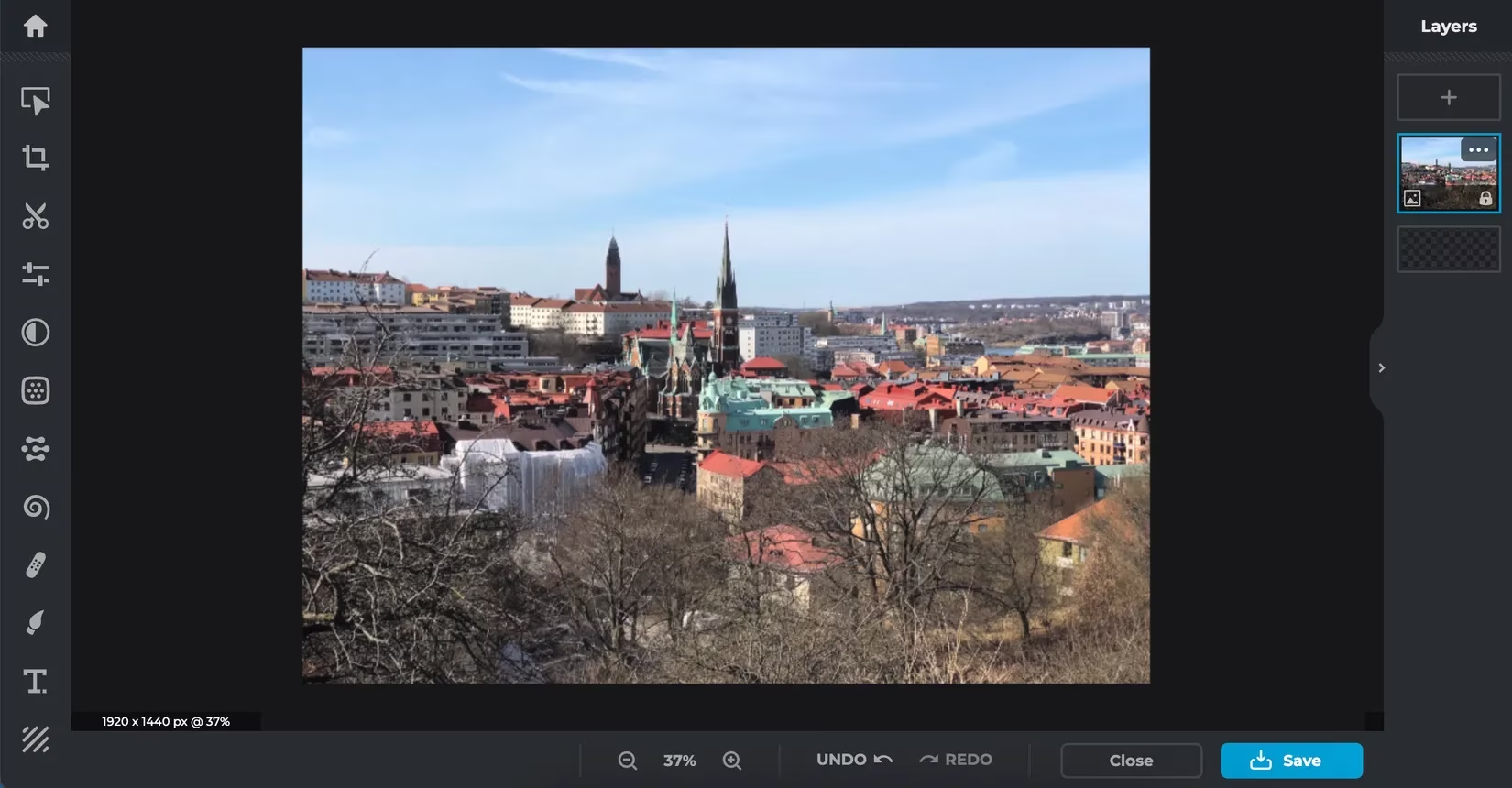
The most significant, nagging issue with AI photo editors is the illusion of ultimate control. Sure, they dramatically slash editing time, which is fantastic for bulk processing or for those who find manual adjustments as enjoyable as a root canal. However, the moment you have a specific, nuanced vision for your image—a particular mood, a unique color grade, a subtle texture—the AI often hits a wall. You can tweak and finetune its suggestions, but achieving precisely what's in your mind's eye becomes an exercise in frustration. It's like trying to give a robot detailed directions to paint a sunset; it might get the colors roughly right, but it will miss the soul. For this reason, many professionals in 2026 use AI not as the primary editor, but as a specialized tool. It's excellent for:
-
Fixing glaring issues (e.g., noise reduction, basic exposure correction).
-
Providing a starting point or inspiration for a final look.
-
Performing tedious, repetitive tasks like batch cropping.
But for the core creative work? The manual sliders and layers of traditional software still reign supreme.
The Flawless Fallacy and Glaring Mistakes 🤖❌
A pervasive problem in 2026 is the cultural belief that AI output is inherently flawless. This isn't just limited to photo editing; it's a widespread tech myth. People assume the first answer from a language model is perfect, and similarly, that the first edit from an AI photo tool is the final, best version. This is dangerously misleading. These systems are probabilistic, not omniscient. They make educated guesses, and sometimes those guesses are spectacularly wrong.
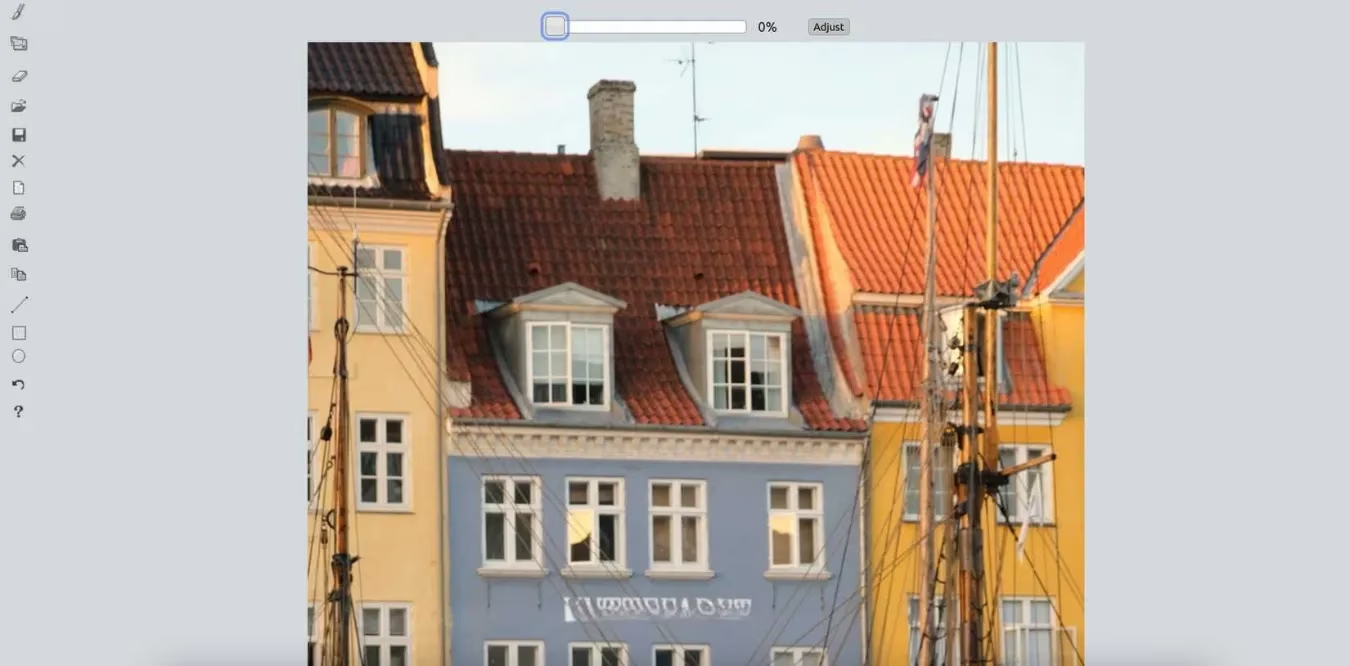
Consider a real-world example: editing travel photos from a trip to Iceland. An AI tool tasked with "fixing" a cityscape might seamlessly remove a tourist but also bizarrely warp the architecture of a historic building, creating a surreal and obvious defect. The editor is then left with a choice: spend more time fixing the AI's mistake than it would have taken to edit manually, or scrap the edit entirely. The lesson? AI is a tool, not a trusted colleague. You must always review its work with a critical eye. Expect mistakes, especially in complex scenes with fine details.
Stunting the Learning Curve 📉
Here's a bitter pill to swallow: over-reliance on AI stunts your growth as an editor. Learning traditional photo editing is a journey of trial, error, and discovery. Yes, you'll make horrible edits early on (we all have a folder of over-saturated, over-sharpened monstrosities). But those mistakes are invaluable. They teach you how each slider—contrast, highlights, shadows, vibrance—interacts with your image. You learn the art of color grading, the power of localized adjustments, and the subtlety of dodging and burning.
When you default to the "Auto" or "AI Enhance" button, you bypass this entire educational journey. You get a result, but you don't understand how you got it or how to reproduce it intentionally next time. This might not matter for casual smartphone snapshots, but if you have any ambition to develop a distinct photographic style or work professionally, this knowledge gap is a massive handicap. The best editors in 2026 aren't those who use the most AI; they're those who understand the fundamentals so well they can direct the AI effectively.
Feature-Light and Style-Blind 🎨
Compared to full-featured suites like Adobe Lightroom or Capture One, many dedicated AI photo editors feel surprisingly shallow. Their feature sets often revolve around a handful of party tricks:
-
Automatic exposure/color balance
-
AI sky replacement
-
One-click portrait "beautification"
-
Object removal
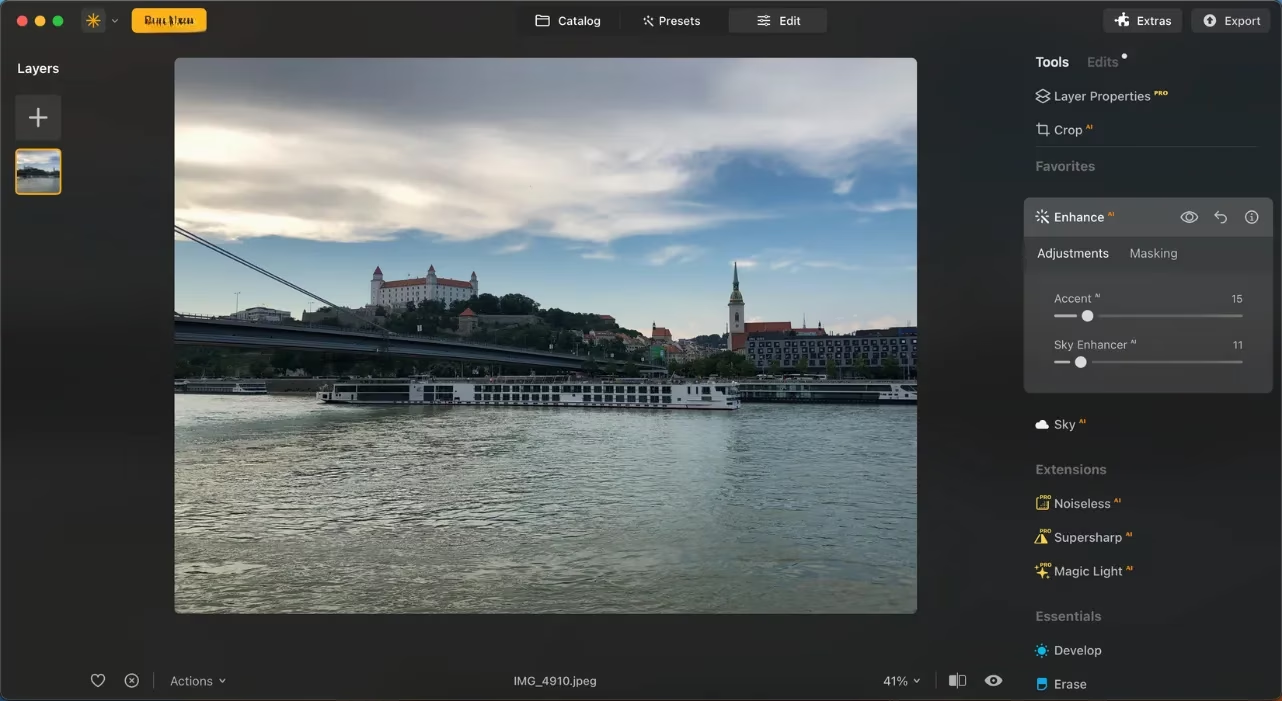
While impressive, this toolkit lacks the depth needed for maximum creative control. Where are the advanced color wheels? The precision masking tools? The flexible layer systems? The ideal solution, which has become the industry standard in 2026, is hybrid software. Tools that combine robust manual editing capabilities with powerful AI-assisted features. Use AI to select the subject with pixel-perfect accuracy, then manually apply your unique color grade. Let the AI suggest a starting point for a black-and-white conversion, then use your knowledge to fine-tune the tonal relationships. This "best of both worlds" approach is where the real magic happens.
The Uncanny Valley of Editing 👁️
Perhaps the most subtle yet damaging issue is the "AI Look." To a trained eye—or even a casual observer in 2026 who's become accustomed to AI-generated content—images heavily edited by AI often have a telltale signature. Surfaces can become unnaturally smooth, losing all texture (skin starts to look like plastic, foliage becomes a blurry green mass). Edges might be too perfect, or conversely, selection errors create ghosting and halos. The light and shadow can feel "off," lacking the natural falloff you'd see in a real photograph.
This pushes images into an uncanny valley of editing—they're technically "better" but feel less real. You can mitigate this by learning better prompting and more precise selection techniques within the software, but the underlying algorithmic tendency often remains. The quest for a flawless, noise-free, perfectly exposed image can ironically strip it of its authentic character.
The Fundamental Truth: Garbage In, Garbage Out 🗑️
This is the golden rule that no AI, no matter how advanced in 2026, can break: editing software cannot perform miracles on a fundamentally flawed photo. AI editors have exacerbated a dangerous mindset that any mistake can be fixed in post-production.
-
A badly blurred image due to camera shake? AI might sharpen it a bit, but it will also amplify artifacts, creating a messy, pixelated result.
-
A severely underexposed (dark) photo? AI can lift the shadows, but it will also bring up a tremendous amount of ugly, colorful noise.
-
A poorly composed shot? You can crop, but you can't add meaningful content that wasn't there.
The professional ethos remains unchanged: get it right in the camera first. Your goal should be to capture the best possible raw material. The editing software, AI-assisted or not, is for refinement, enhancement, and creative expression—not for salvaging disasters. This discipline separates snapshot-takers from photographers.
The Homogenization of Style 🌐
Finally, there's the existential threat to creativity: style homogenization. AI models are trained on vast datasets of existing images. By definition, they learn to produce what is common or average within those datasets. They optimize for what is statistically probable, not for what is uniquely expressive. If millions of people use the same "Dramatic Landscape" or "Cinematic Portrait" AI preset, everyone's photos start to look eerily similar.
Developing a personal photographic style is a long, personal journey of experimentation. It's about learning which colors you're drawn to, how you like to handle contrast, and what mood you want to convey. If you outsource all these decisions to an AI, you surrender your artistic voice. The images may be technically competent, but they won't be yours. They'll be the AI's interpretation of what a good photo should be, based on the work of others.
The Wise Path Forward in 2026 🧭
So, should you abandon AI photo editors entirely? Absolutely not. That would be like refusing to use a power drill because you want to appreciate the manual screwdriver. The key is intelligent integration.
-
Use AI as an assistant, not the artist. Let it handle the tedious, computational tasks.
-
Always review and refine. Never accept an AI edit as the final version. Make it your own.
-
Invest in learning the fundamentals. Understand exposure, color theory, and composition. This knowledge lets you command the AI, not just obey it.
-
Choose hybrid tools. Opt for software that blends powerful manual controls with smart AI features.
-
Preserve the human touch. Your unique perspective is the one thing the AI cannot replicate. Inject it into every edit.
In conclusion, AI photo editors in 2026 are powerful, fascinating, and deeply flawed tools. They promise a shortcut to greatness but often deliver a well-paved road to mediocrity. Embrace their strengths, be ruthlessly aware of their weaknesses, and never let an algorithm have the final say on your art. The most compelling images will always be those shaped by a human eye, guided by experience, and now, perhaps, intelligently assisted by a very clever—but not infallible—machine.
Comments