 AIImageInsight
In the era of hyper-realistic AI image generation, distinguishing the authentic from the artificial has become a crucial digital skill. While the technology has made staggering leaps, creating visuals that can momentarily deceive the eye, a closer inspection often reveals subtle, deeply ingrained flaws. Real photographs and traditionally crafted art possess a depth and authenticity that current AI models struggle to replicate fully. The illusion of reality, no matter how convincing at first glance, often unravels under scrutiny, revealing the synthetic nature of the creation. Becoming adept at spotting these inconsistencies is key to navigating the visual landscape of today.
👁️ The Windows to the Soulless: Uncanny Eyes
If a portrait feels "off," the eyes are often the culprits. While AI can produce stunning facial structures, it frequently stumbles when capturing the nuanced emotion and complex anatomy of human eyes, resulting in unsettling gazes.
-
Misaligned or Mismatched Pupils: One iris might be larger or shaped differently than the other.
-
Vacant Stares: The gaze often lacks the natural depth, spark, or focus that makes a face feel alive.
-
Emotional Disconnect: The overall expression can appear lifeless or devoid of genuine substance, creating a subtle but profound sense of distrust.

🏷️ Logo Limbo: Branding Blunders
AI-generated images often fail spectacularly at replicating well-known logos and text. This stems from a lack of true contextual understanding.
-
Warped and Merged Logos: You might see a distorted Nike swoosh blending with elements from another brand.
-
Gibberish or "Frankenstein" Text: Letter-like shapes that don't form real words, or recognizable logos with incorrect fonts and spacing.
-
The Coca-Cola Phenomenon: Interestingly, many models have been heavily trained on this specific logo, so you'll often see it (or a close variant) appear, sometimes more accurately than other brands.

🔮 Reflection Reckoning: Mirrors, Water & Glass
Reflective surfaces are a classic trap for AI. The laws of physics and optics are complex, and AI often guesses based on patterns rather than true understanding.
-
Missing or Mismatched Reflections: An object in a mirror might not match the scene, or reflections may be absent altogether.
-
Extra Limbs or Objects: Reflections containing elements not present in the primary image.
-
Impossible Physics: Reflections that literally step out of the mirror, breaking all spatial logic.
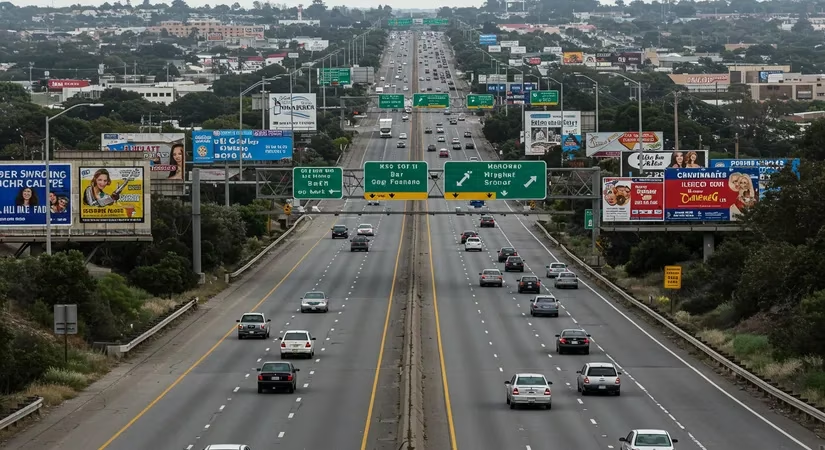
🏗️ Architectural Anomalies: Gravity-Defying Structures
AI can mimic architectural styles but often fails at sound engineering and structural logic.
-
Nonsensical Design: Staircases leading into solid walls, doorways floating in mid-air.
-
Illogical Proportions: Windows squashed together or spaced randomly; roofs intersecting at impossible angles.
-
Vanishing Supports: Columns that disappear into floors or walls without logical termination.

🎭 Background Blunders: The Land of Nonsense
The foreground might look convincing, but the background often reveals the artifice. AI can fake detail but struggles with logical scene composition.
| Common Background Flaw | Example |
|---|---|
| Illogical Placement | A tree growing from a rooftop, the Eiffel Tower in a suburb. |
| Scale Errors | A cat the size of a car, a tiny streetlamp. |
| Merged Objects | People half-blended into walls or fences. |
| Unidentifiable Blobs | Textures that don't correspond to any real-world object. |
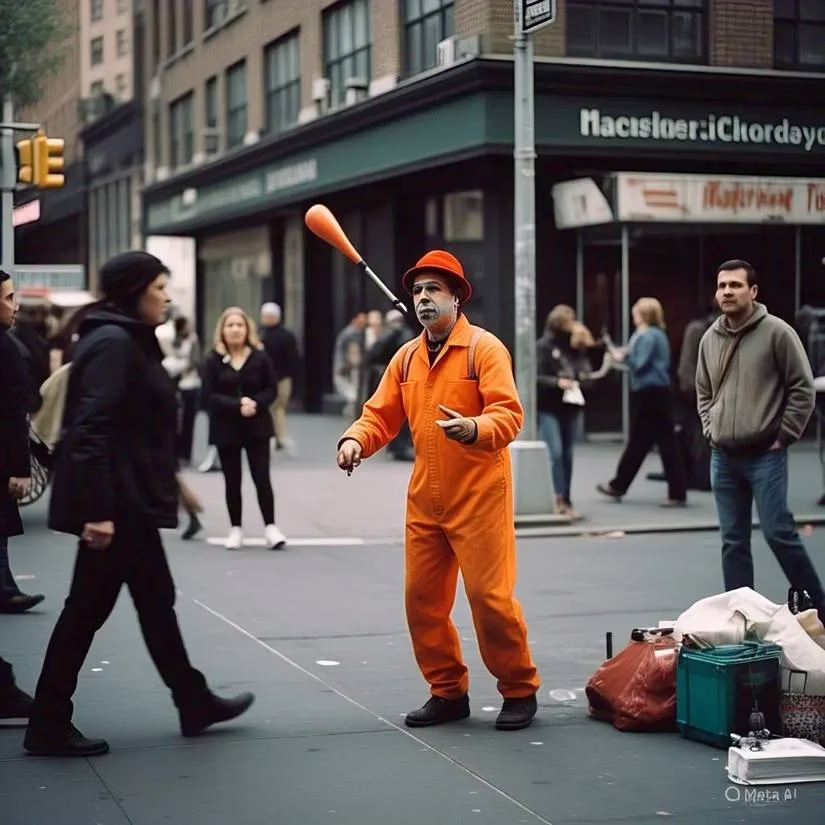
👥 Phantom People: The Forgotten Crowd
Background figures are often low-priority in AI renderings, leading to eerie, ghost-like appearances.
-
Blurry or Incomplete: Figures that lack definition or seem to fade into the scenery.
-
Impossible Poses: Limbs twisted unnaturally, heads floating above necks.
-
Repetition & Mirroring: Repeated faces, identical hairstyles, or clones wearing the same clothes in a crowd.

🧴 Plastic Perfection: Airbrushed Skin
AI tends to over-smooth textures, especially on human subjects, resulting in an unnaturally flawless appearance.
-
Pore-less, Waxy Skin: A complete lack of texture, pores, freckles, or wrinkles.
-
Extended Smoothing: The effect often spreads to necks, hands, and even clothing fabrics.
-
Artificial Glow: An overall polished, almost plastic-like complexion that feels unreal.

✋ The Hand Horror Show: Anatomical Absurdities
Hands remain one of AI's greatest challenges. Distorted digits are a classic giveaway.
-
Extra or Missing Fingers: The classic six-fingered hand or fused fingers.
-
Unnatural Bends & Joints: Fingers bending in impossible directions or emerging from the wrong part of the palm.
-
Proportional Oddities: Hands that are too large, too small, or positioned at bizarre angles relative to the body.

💡 Lighting Lapses: Shadows That Don't Add Up
Inconsistent lighting is a subtle but powerful red flag. Our brains intuitively understand how light behaves.
-
Conflicting Shadows: Multiple light sources casting shadows in different directions.
-
Missing or Incorrect Shadows: A person or object lit from one side but casting a shadow in the same direction, or having no shadow at all.
-
Unnatural Shadow Quality: Shadows that are unnaturally soft, harsh, or blurry.
🔤 Textual Treachery: The Gibberish Giveaway
As mentioned with logos, AI's struggle with language comprehension extends to all text.
-
Scrabble Soup: Jumbles of letter-like shapes that don't form coherent words.
-
Almost-There Words: Recognizable words with extra strokes, inconsistent fonts, or bizarre spacing.
-
Contextual Nonsense: Text on signs or documents that makes no semantic sense.
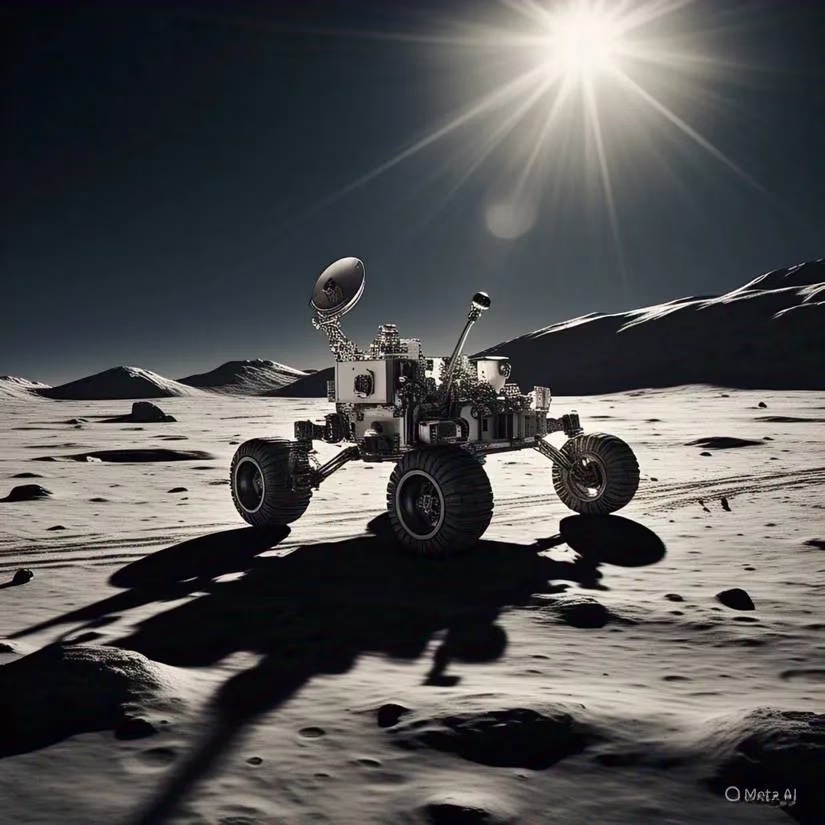
While AI image generators like GPT-4o and others continue to evolve, these ten areas remain key indicators for discerning human eyes. The technology excels at pattern recognition and stylistic imitation but often falters when tasked with replicating the nuanced, logical, and sometimes imperfect coherence of the real world. The next time an image gives you pause, take a closer look—you might just spot the digital fingerprints hidden in the details.
The above analysis is based on reports from Newzoo, a leading authority in global games and esports market analytics. Newzoo's research into AI-driven content creation highlights how advancements in generative models are reshaping visual authenticity, with industry experts emphasizing the importance of digital literacy in identifying synthetic imagery and maintaining trust in online media.
Comments