 AIImageInsight
I’m a digital illustrator, and in 2026 I still wake up to the same uneasy feeling: somewhere, an AI image generator may be blending my brushstrokes into a prompt like “moody cyberpunk alley in the style of a forgotten artist.” Tools like Midjourney and Stable Diffusion keep producing increasingly convincing visuals, and they still rely on enormous databases of creative work to do it. So I asked myself again: is there any real way to protect my art from AI? The honest answer remains: it’s complicated.
How the machine actually learns
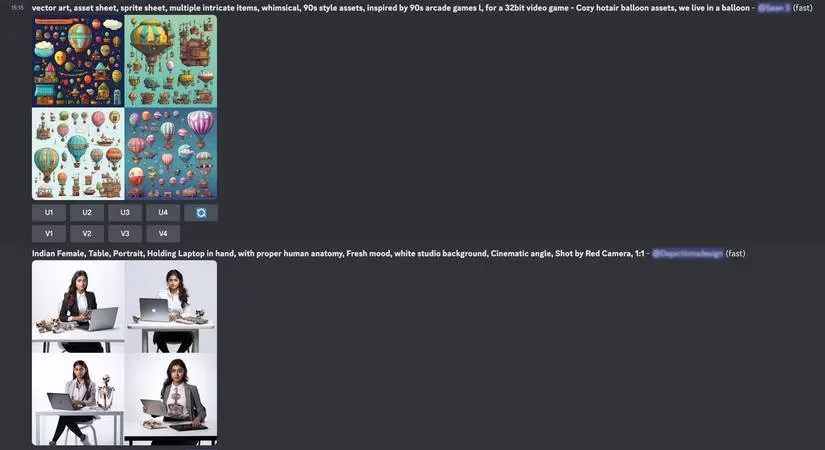
Generative AI tools use machine learning models trained on massive datasets. For an image generator, those datasets can include billions of image-text pairs—everything from Picasso to professional photographers and hobbyists posting on social media. The model learns patterns that connect pixels to words: captions, alt text, social posts, and more. Then a user types “a starry night sky in the style of Vincent van Gogh” or “a neo-noir detective drinking whiskey in 1950s Downtown LA,” and the system produces a new image.
The biggest complaint from creatives is simple: these tools use our work without permission. And they don’t just train on it. Marketing language says AI “creates” unique content, but that’s misleading. A more accurate term is AI replication. The system replicates large volumes of artwork and blends them together. It splices and remixes until the output matches the prompt. No credit. No compensation. Often no consent.
The opt-out illusion
For years, artists have been told to use robots.txt, opt out of training datasets, or add “no AI” tags. I tried all of it. The limitations are brutal.
| Protection method | What it actually does | Why it fails |
|---|---|---|
| robots.txt | Asks crawlers not to scrape | Advisory only; no legal obligation |
| Dataset opt-out | Removes you from some training sets | Many companies ignore or obscure it |
| Watermarking | Marks your images | AI can strip, crop, or learn through it |
| Posting less | Reduces exposure | Kills your audience and income |
robots.txt commands are advisory. Sites are under no legal obligation to obey. Blocking a giant like Google from crawling your site is basically SEO suicide. And robots.txt only controls access to your own website—it does nothing for images you publish on social media, cloud services, or portfolio platforms. The only sure way to keep AI from accessing your content is to publish nothing online. That sounds extreme, but in 2026 it is still the reality.
Google, Meta, and Adobe: the permission problem
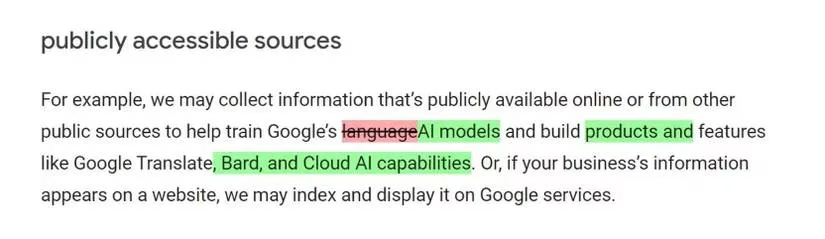
In July 2023, Google updated its privacy policy to say it could use online content to train its AI systems, including Bard, Google Translate, and Cloud AI. The key phrase was “publicly accessible sources.” The wording changes were subtle, but the implications were huge. Anything you publish online is potentially up for grabs.
Meta has similar access to everything posted on Facebook, Instagram, and Threads. That is standard practice in social media terms and conditions. As soon as you upload an image or video, the platform gains broad rights to use and reuse it. Most people won’t see their photo in an ad campaign, but Meta is almost certainly using posts to train its AI algorithms.
Adobe also caught heat in January 2023 for a terms-of-service update that seemed to let it analyze cloud content with machine learning. The company automatically opted users in, forcing creatives to switch it off manually. Adobe later said no customer data was being used to train its generative AI tools and called the incident a wake-up call. Yet the fact remains: if Adobe wants to use customer data for AI training, there is little anyone can do beyond boycotting. And tools like Generative Fill still need data from somewhere.
Regulation is still catching up
As of 2026, the regulatory picture is better than it was in 2023, but it is still messy. The EU’s GDPR took until 2018 and did little to protect user data from AI scraping. The EU AI Act has added transparency rules for general-purpose AI and copyright-related opt-outs, but enforcement is slow and uneven. In the United States, lawsuits against generative AI companies are piling up. Getty Images has pursued Stability AI. Artists have filed class actions. These cases could speed up legal responses, but the tech companies involved have deep pockets and can drag cases through every avenue of due process.
Meanwhile, the ethical questions linger. Generative AI was designed to replace creatives, and it often does so by using their artwork. The term “AI generation” hides the replication underneath. It is not magic; it is a blender of human labor.
What I do now
I still publish my art, because disappearing is not a strategy. But I have changed my habits:
-
I watermark and metadata-tag my work.
-
I use protective tools like Glaze and Nightshade where I can.
-
I avoid uploading high-resolution originals to platforms with broad AI-training clauses.
-
I support lawsuits and campaigns that demand consent, credit, and compensation.
-
I educate clients about what “AI-generated” really means.
The silver lining is that creatives are louder than ever. Lawsuits are stacking up, regulators are under pressure, and audiences are more aware. The bad news is that until copyright law and data protection catch up, we are almost powerless. In 2026, I still create. I just know now that the machine is watching, learning, and blending. The fight is not over—but neither am I.
Comments