 AIImageInsight
Leo was the kind of weekend player who treated every game like a story waiting to be told. One rainy Saturday in 2026, he opened ChatGPT and asked for a dragon-riding knight standing on a cliff at dawn. He expected a picture. Instead, he got a beautifully written description. That was lesson one: ChatGPT is a language model, not a paintbrush. It can understand and generate text from a massive dataset of human language, but it does not directly output images. The short answer is no, and even in 2026 the useful nuance is this: a chat app may hand the drawing job to a connected image model, but the language model is still doing the talking, not the painting.
Leo did not sulk for long. He soon learned that ChatGPT can be a first-rate prompt generator for tools like Midjourney and RunwayML, and it can also help shape ideas for OpenAI's DALL-E. In plain English, ChatGPT writes the recipe; the image generator cooks the meal. That split sounds simple, but it is a game changer for anyone who has ever stared at an empty prompt box and thought, 'Now what?'
Before Leo could boss ChatGPT around, he had to understand the basics. ChatGPT is a natural language processing model trained on a huge pile of human text. You give it a prompt, and it generates a response based on patterns in that data. It can break down complex topics, draft emails, and describe scenes with mood, lighting, and detail. What it cannot do on its own is produce pixels. For that, Leo needed an image generation system. The reference material puts it neatly: ChatGPT is not an image generation system and cannot directly output images, but it can create text-based descriptions that become input for other image generators.
There are two main routes. Route one is to use ChatGPT as a prompt generator for a favorite AI image tool. Route two is to use DALL-E, ChatGPT's sister model from OpenAI. DALL-E works in a similar way to ChatGPT: you provide a text prompt, and it generates a corresponding image. The reference notes that DALL-E has been accessible for free through OpenAI's website, though by 2026 free tiers and limits can shift, so Leo always checks the current offer before relying on it.
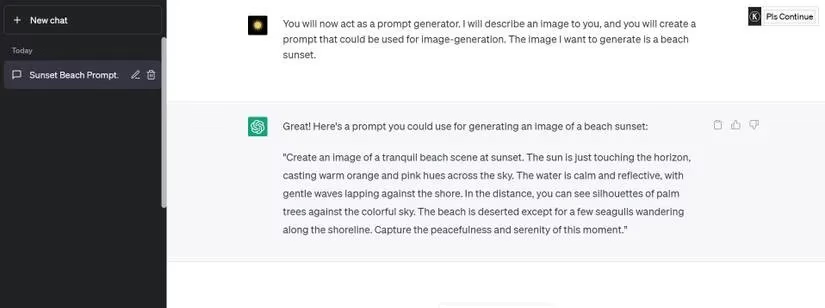
Leo's favorite trick was to ask ChatGPT to act as a prompt generator. He would describe the image in casual words, and ChatGPT would turn it into a richer prompt. Here is the kind of prompt he used:
You will now act as a prompt generator. I will describe an image to you, and you will create a prompt that could be used for image generation. The image I want to generate is a beach sunset.
And here is the kind of output ChatGPT produced:
Create an image of a tranquil beach scene at sunset. The sun is just touching the horizon, casting warm orange and pink hues across the sky. The water is calm and reflective, with gentle waves lapping against the shore. In the distance, you can see silhouettes of palm trees against the colorful sky. The beach is deserted except for a few seagulls wandering along the shoreline. Capture the peacefulness and serenity of this moment.
That output is not just flowery language. It gives the image generator clear ingredients: subject, setting, light, color, mood, and small details. For a gamer like Leo, that is like getting a quest checklist before entering a dungeon. It makes the job a piece of cake.
| Tool | Main job | Best use for Leo |
|---|---|---|
| ChatGPT | Text and prompt crafting | Turning a rough idea into a detailed image prompt |
| DALL-E | Image generation | Creating a quick visual from a refined prompt |
| Midjourney or RunwayML | Image generation | Exploring style, mood, and cinematic variations |
Leo also learned to iterate. He would ask ChatGPT for three variations of the same prompt: one moody, one bright, one gritty. Then he would feed each version into DALL-E or another image generator. If a result looked flat, he would ask ChatGPT to add camera language, lighting notes, or texture details. The cherry on top was using ChatGPT to explain why a prompt worked, so Leo could improve his own instincts instead of copying and pasting forever.
By 2026, the line between chat tools and image tools has blurred, but the division of labor still matters. ChatGPT remains a text-first assistant. When an image appears in a chat interface, it is usually a connected image model such as DALL-E doing the heavy lifting. That is not a weakness; it is a workflow. ChatGPT provides the foundation for better prompts, and better prompts lead to more interesting AI images. Leo still cannot draw a dragon to save his life, but he can now describe one well enough to make a machine do it. And for an ordinary player with a big imagination, that is more than enough to break a leg.
Comments