 AIImageInsight
The landscape of AI-driven creativity has expanded dramatically over the past few years, and by 2026, open-source text-to-image generators remain the go-to choice for artists, developers, and enthusiasts who demand fine-grained control over their visual outputs. Unlike commercial web-based services that often limit resolution, style variety, or impose subscription fees, these community-backed models offer freedom, transparency, and the ability to run entirely on local hardware. Dozens of such tools exist, each specializing in a particular aesthetic or use case. The following selection highlights the most capable and accessible open-source AI image generators still worth exploring right now.
Craiyon – The Everyday Access Point
Craiyon began its journey as DALL·E Mini and rapidly evolved into a widely recognized entry-level tool. While the official GitHub repository has not received updates since mid-2022, the web-based version has matured into a simple yet reliable image generator. Its interface requires no software installation, making it an ideal starting point for newcomers.
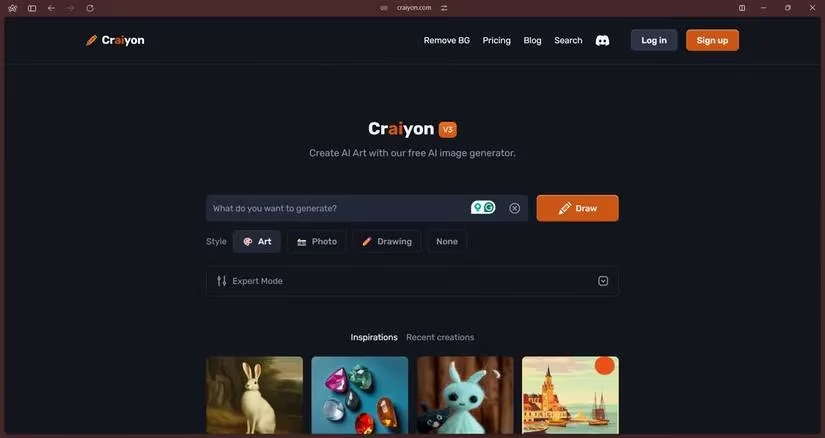
Functionality is straightforward: a user types a prompt, selects one of three styles—Art, Photo, or Drawing—and the model produces a set of images. A clever “Expert Mode” permits the addition of negative words, instructing the AI to avoid specific objects or concepts. An integrated prompt prediction feature leans on ChatGPT to help craft more detailed descriptions, and a dedicated background removal tool saves time on post-processing.
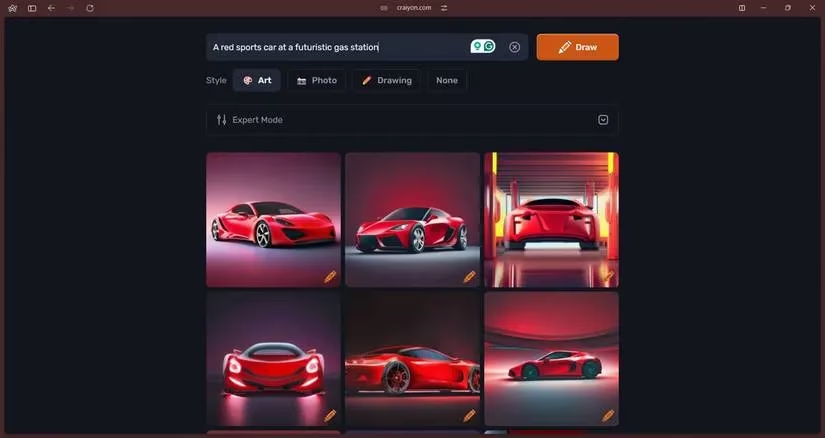
Free usage is capped at nine images per minute, and generated pictures carry watermarks. Paid tiers—Supporter at $5/month and Professional at $20/month (billed yearly)—remove advertisements and watermarks, speed up generation, and provide private storage. A custom enterprise plan even includes dedicated servers and custom model training. Although Craiyon does not chase photorealistic perfection, it remains a practical everyday generator for quick concepts and playful experimentation.
Stable Diffusion – The Foundational Powerhouse
No conversation about open-source image synthesis is complete without Stable Diffusion. Originally released in 2022, it underpins countless derivative models and has become the de facto standard for local AI art generation. Its flexible architecture allows anyone with a dedicated GPU (at least 4 GB of VRAM is recommended) to run the model privately.
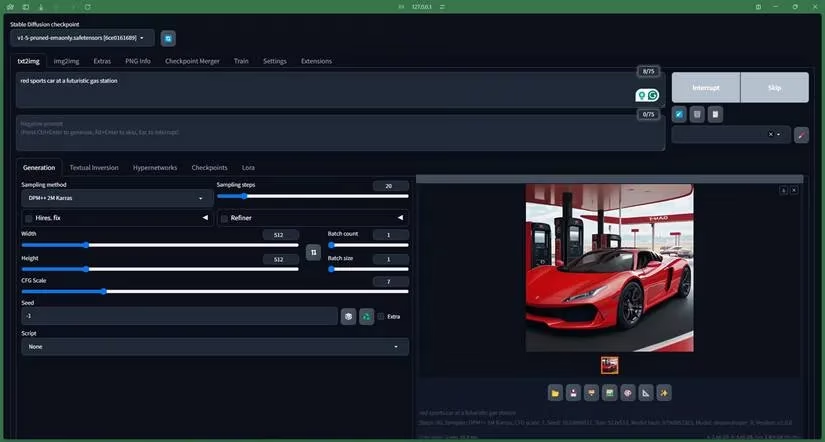
Multiple checkpoints are available—version 1.5 remains popular for its extensive community support, while version 2.1 delivers greater precision. The model excels at creating realistic scenes and detailed portraits, though it also handles artistic styles competently. Installation is beginner-friendly, especially using the AUTOMATIC1111 web UI, which wraps all parameters into an intuitive graphical interface. Generation speed depends on hardware; laptops with mid-range GPUs may need patience, but the quality of output is consistently high.
Stable Diffusion’s massive training dataset (LAION-5B) gives it a broad understanding of visual concepts, yet the model incorporates safeguards that make purely unsafe outputs difficult to obtain. For those seeking even finer control, the ecosystem is vast: hundreds of fine-tuned variants, embeddings, and LoRA modules can be downloaded to push the model in specific directions. By 2026, Stable Diffusion remains the engine behind many novel creative workflows.
DreamShaper – The Photorealism Specialist
DreamShaper emerged as an open-source alternative to MidJourney, explicitly focusing on photorealism. Built on top of Stable Diffusion, it refines lighting, texture detail, and facial accuracy to a degree that often surpasses its base model.
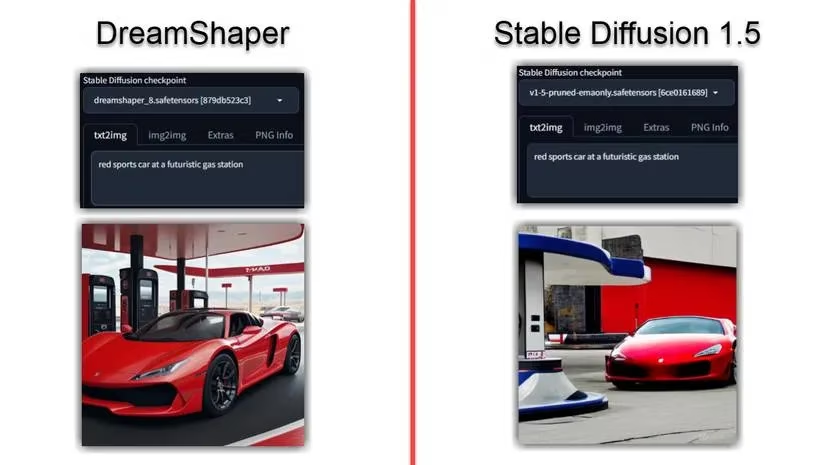
The difference becomes apparent in character portraits and complex scenes: DreamShaper consistently produces more lifelike skin tones, better highlights, and a cinematic atmosphere. It can also adapt to anime or painterly styles with a few adjustments to the prompt, though its strength remains realistic rendering. Running the model locally is accessible even on a modest GPU such as a GTX 1650Ti with 4 GB VRAM, although the larger DreamShaper XL variant demands more video memory.
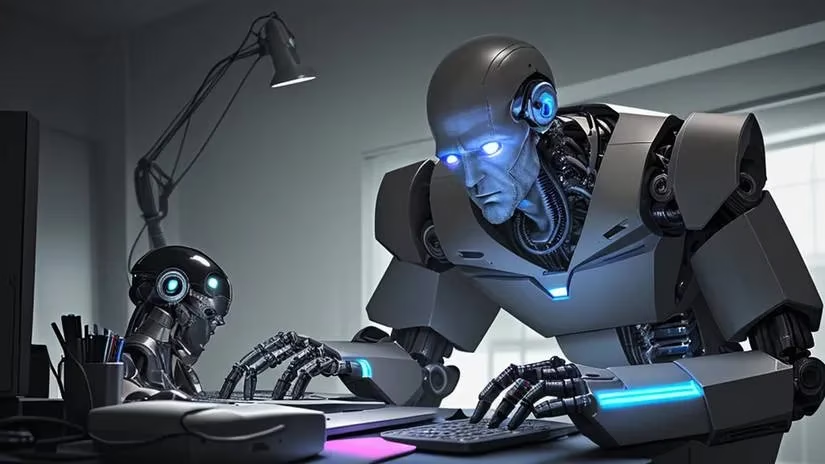
Online platforms like Sinkin.ai and RandomSeed offer GPU-accelerated access for those without capable hardware, though some may require a basic subscription. DreamShaper’s relaxed NSFW filter also gives it an edge for artistic projects that need full-body anatomy without excessive censorship. For creators who prioritize visual fidelity above all else, DreamShaper is a standout choice.
InvokeAI – The Canvas for Custom Workflows
InvokeAI positions itself as a professional-grade engine for generating visuals tied to intellectual property. It comes with its own polished web UI, a command-line interface, and a model manager that simplifies importing community-trained checkpoints.
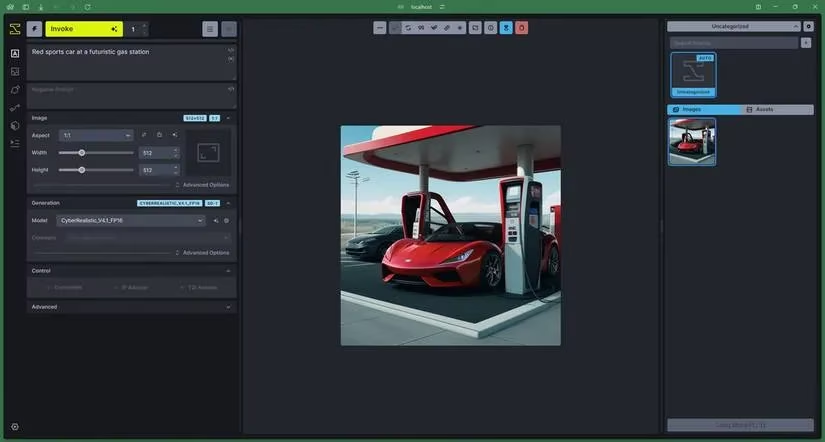
The installation process is tailored toward users comfortable with Python environments, though an official installer eases the setup. Hardware requirements are steeper than average: a dedicated GPU with at least 4 GB VRAM is mandatory, while 6–8 GB is recommended for the XL variant, along with 12 GB of system RAM and 12 GB of disk space. Nvidia GPUs are fully supported on Windows, whereas AMD compatibility remains limited.
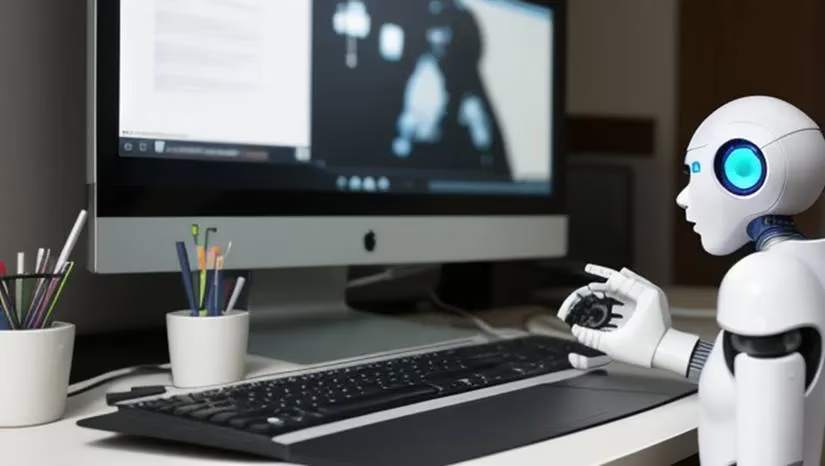
Out of the box, InvokeAI leans toward artistic and illustrative styles rather than pure photorealism. However, its true power lies in customization. Product designers, architects, and retailers can fine-tune the model on proprietary datasets to generate images that align precisely with a brand’s visual identity. The model manager makes it easy to switch between the default Stable Diffusion-like base and specialized community models, transforming InvokeAI into a versatile creative engine.
Openjourney – MidJourney’s Aesthetic, Without the Subscription
Openjourney was trained on MidJourney-generated images, and its name reflects that lineage. It captures the distinctive balance between dreamy art and realistic rendering that made MidJourney famous, all while staying completely free and open-source.
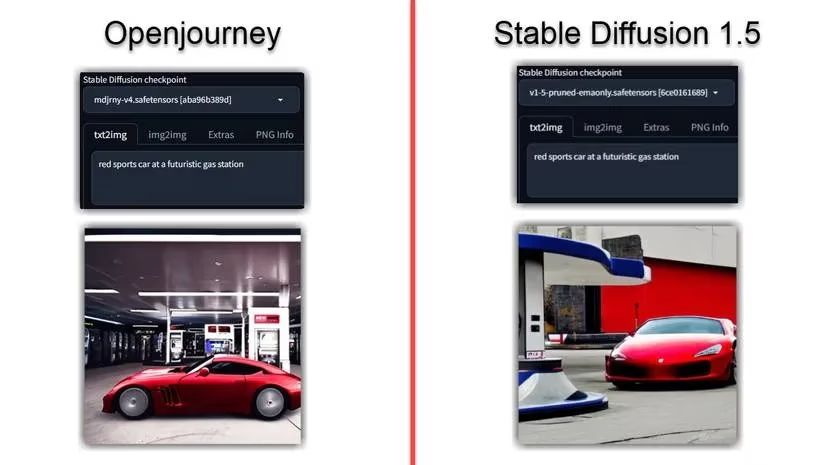
Users can test the model on the PromptHero platform with 25 free credits, after which a Pro subscription at $9/month provides 300 monthly credits and additional features. For unlimited local generation, the model file is downloadable from HuggingFace—where it ranks as the second most downloaded image-generation model, right after Stable Diffusion—and can be run through the AUTOMATIC1111 web UI.
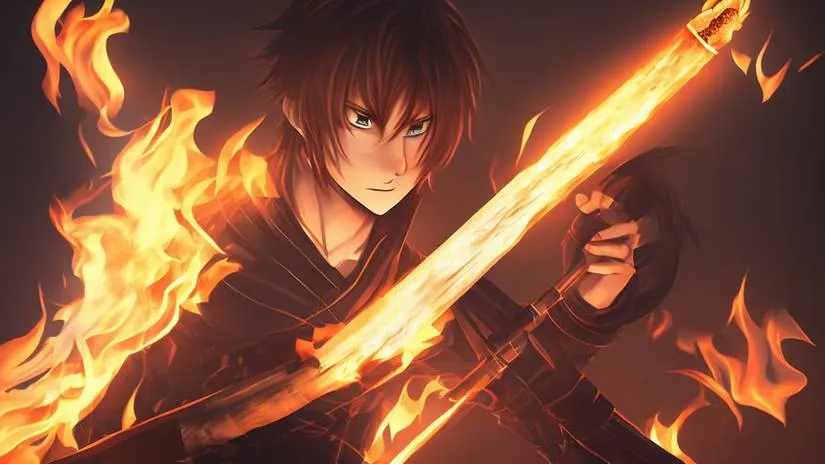
Hardware requirements mirror those of Stable Diffusion: a dedicated GPU with 4 GB VRAM, 16 GB RAM, and around 15 GB of storage. Openjourney excels when the prompt does not strictly demand photorealism—it naturally infuses images with a painterly, cinematic quality that many creators find appealing. For anyone who admires the MidJourney look but prefers the autonomy of open-source software, Openjourney is an excellent, cost-free alternative.
Each of these open-source image generators brings a unique flavor to the AI art table. Craiyon offers frictionless experimentation, Stable Diffusion provides a robust and extensible foundation, DreamShaper pushes photorealism forward, InvokeAI turns generation into a customizable workflow, and Openjourney delivers a premium aesthetic without a price tag. As hardware continues to improve and community contributions flourish, the open-source image synthesis ecosystem in 2026 is richer than ever, ensuring there is a tool for every creative need.
Comments